Wednesday, March 10, 2010

Purslane fights xenoestrogens!


There has been some talk lately about environmental estrogens and for good reason. The National Toxicology Program has some concern that these endocrine disruptors may cause problems with human development and reproduction. Endocrine disrupters act like hormones to interfere with normal function of body hormones such as estrogen. These xenoestrogens can be byproducts of industrial, agricultural and chemical companies and can act as estrogens in both humans and wildlife causing potential ecological and human health impact.
One of these endocrine disruptors is Bisphenol A or BPA which is produced in the production of polycarbonate plastics and epoxy resins. It can be found in foods and beverages because of leaching from packaging. Plastics made from BPA typically have a #7 on the bottom as their recycling code.

http://www.niehs.nih.gov/news/media/questions/sya-bpa.cfm

An interesting study recently has found that the common garden weed, purslane, may have a very practical use in removing BPA from landfill leachates and industrial wastewater, a process known as bioremediation.
In this study, Japanese scientists from Osaka University incubated bacteria free cultures of Portulaca oleracea (purslane) with the endocrine disruptor, bisphenol A (BPA). The concentration of BPA used was one that is frequently detected in landfill leachates (50 micromolar).
BPA levels in the water began decreasing almost immediately after incubation with P. oleracea with more that 90% of the BPA removed from the water within a 24 hour period. Controls were used to verify that BPA removal did not occur without the presence of the plant. In addition to looking for the actual presence of the BPA chemical, activity measurements confirmed that BPA was indeed removed from the water.
Scientists confirmed that the plant was not simply absorbing the BPA and accumulating it in its own tissue and speculated that the plant was metabolizing BPA into a compound that does not have endocrine-disrupting activity.
Besides BPA, scientists also found that P. oleracea was able to remove several other previously identified endocrine disruptors as well. Although over 100 typical garden plants were used in this study, P. oleracea was the most successful.
As if this weren’t enough, purslane is an edible weed that is very high in omega 3 fatty acids. In many parts of the world it is eaten as a vegetable. It should be coming up in many areas now as spring approaches. Look for it in your yard and consider tossing some in a salad – of course make sure it is grown in a clean place.

Imai, S. Shiraishe, A., Gamo, K., et al., Removal of phenolic endocrine disruptors by Portulaca oleracea. J. Biosci. Bioeng. 2007;420-426.

Tuesday, March 2, 2010

Saving Our Natural Skin Care Products


Monday was a small victory for those of us in the skin care business. The Colorado Legislative Committee turned down a bill that would have eliminated many of the ingredients used by both small and large manufacturers and loved by customers. Ironically, the very people who are trying to take these things away from us are the people telling you they are trying to protect them; the Campaign for Safe Cosmetics. Its very unclear to me what their motive is and that of their parent group the Environmental Working Group. Out of an apparent fear of chemistry they want to ban an extraordinary number of chemicals from skin care, chemicals that we eat in our food everyday. Their fear of chemistry is such that it prevents them from seeing that many of the chemicals they would like to ban are ubiquitous chemicals occurring naturally in our environment; chemicals that compose the aroma molecules of essential oils, the antioxidants of vegetable oils, and miscellaneous molecules of fruits, vegetables and herbs. Did the relatively few small businesses that supported this bill even read the list of substances to be banned? I doubt it. If they had they would see that passing this bill would have made it impossible for any cosmetic company to manufacture or sell in the state of Colorado, including themselves. Following is a summary of the afternoon in the legislature.

Initially there was much questioning directed toward Representative Primavera about wording of the bill and why the EU should govern what we do. It was decided that those opposed to the bill would speak first with a total time limit for the entire opposition at 40min (not including questions). The Personal Care Products Council (a trade organization) was the first to speak addressing that the US has had legislation in place to control cosmetics ingredients for many years, longer than the EU.

Some of the speakers were:
Dr. Richard Adamson, NIH, Dr. Philip Guzelian, University of Colorado, Mike Thompson and John Bailey, Personal Care Products Council, Tim Long, Proctor and Gamble, Jordan Lipp a private lawyer, Alan Lewis of Vitamin Cottage, Jerrel & Ellisa Klaver from Salus, one Avon sales associate and myself, Cindy Jones, Ph.D. of Sagescript Institute.

Testimony included these points:
Most things on the list are not carcinogenic or not carcinogenic at levels found in cosmetics.
FDA oversees cosmetics and has done so since the 1970's (Long before the EU did).
Even though the EU bans 1100 chemicals from cosmetics most of those have no relation to cosmetics and include things like diesel fuel.
Many things on the list are regulated more in the US because they are considered OTC drugs here whereas in Europe they are not.
The bill would hurt not only large business but also small businesses making it impossible to manufacture or sell cosmetics in Colorado.
Even considering just the amended version of the bill; because analytical testing ability for substances like lead and arsenic are so sensitive it would be impossible to find any product that did not contain these ubiquitous molecules.
Substances on the lists including acetaldehyde, caffeic acid, methyleugenol, 5-methoxy psoralen, (2-ethylhexyl)phthalate, and safrole may sound scary, but are a natural part of many fruits, vegetables, herbs and essential oils. Non-steroidal estrogens are a natural part of vegetable oils.
There is no evidence that anyone has been harmed by any of the ingredients on the lists.
The law is most likely unconstitutional and opens things wide for law suits that do not have to show harm or even have a client.

Those speaking in favor of the bill included Susan Rolle of the Women's Lobby and cofounder of the Campaign for Safe Cosmetics. In favor of the bill she said "I wish we had more science but we don't". She mentioned several times that cosmetics companies sold different, safer products in the EU than here, but when pressed she could only name one company who did that and sold nail products rather than skin products.
Their scientific expert, Dr. David Norris from University of Colorado, is an environmental ecologist. He addressed the number of environmental estrogens in the waterways and their effects on fish. But he admitted that they probably do not come from cosmetics and that there was no way to identify naturally occurring ones from those that originated in cosmetics. Other proponents included an RN who didn't like the chemical smell of one of the hospital products she was using and a business owner who thought that natural was better. And no, I don't know what these statements had to do with the bill either.

I want to thank Proctor and Gamble, Johnson & Johnson, Estee Lauder, and the Personal Care Products Council for coming. We didn't expect big business there but were glad for the support. Next time call ahead and you can take some small business leaders to dinner!

So there may be some work to do in the cosmetics field to make it safer and perhaps 'self-policing' is not working as well as it should, broad legislation that makes it impossible to work within its bounds is ridiculous. And adding new laws is rarely the answer to any problem.

Hopefully my next blog post will be something more fun.

Wednesday, February 24, 2010

Colorado Safe Cosmetics Bill

A bill was recently introduced into the Colorado House that is of concern to me and should be a concern to other manufacturers and users of cosmetics, House Bill 1248 the Colorado Safe Personal Care Products Act. With good intent this bill proposes to make our cosmetics and personal care products safer. Who could argue that? But there are flaws with the bill that would diminish the aesthetic value of our cosmetics and harm small businesses while doing nothing to actually protect the cosmetic user. The author of this bill, Rep. Diane Primavera (D-Broomfield), is a cancer survivor. With no obvious answers as to why she got cancer she decided to blame her personal care products and thought steps should be taken to protect them. Well I’m not saying there is no work to be done in making cosmetics safer, but let me explain some of this bill to you. This bill bans cosmetics that contain any substance deemed a carcinogen or probable carcinogen by the following:


EPA Group A, Group B1 and Group 2B

International Research Committee on Cancer group 1, Group 2A and Group 2B

National Toxicology Program list of reproductive toxicity

NIOSH list of potential occupational carcinogens

Or identified by the FDA as a carcinogen.


One argument for this bill has been that in the European Union roughly 1,100 chemicals are banned from cosmetics while the Food and Drug Administration only bans 10. However, numbers can be deceiving and many of the 1,100 chemicals that are banned are not things that are even used in cosmetics. Nor are most of the substances found on the above lists would never be used in cosmetics. Do we really need to take the time to outlaw glass wool and plutonium from our cosmetics when they would not be used in the first place?


After reading over the lists, there are a few things on the lists of interest that you may want to know about.

1. Alcohol (ethanol) – Sure excessive drinking can cause liver damage and cancer. However, there is no evidence that alcohol on the skin causes any damage. Some cosmetics companies are using alcohol as an alternative preservative to prevent bacterial growth. Alcohol is also a common solvent used by natural perfumers.


2. Lead – no, lead should not be in cosmetics, however, lead is found in probably all water sources. Since this bill does not address limits, any product containing water could be banned.


3. Coffee – did you have your cup this morning? I hope you didn’t get it on your skin. Coffee is used in some cosmetics products such as shower scrubs because there is evidence that it can help prevent cellulite.


4. Pickled vegetables – ok, not a cosmetic ingredient but should a pickle with your sandwich be outlawed?


5. Methyl eugenol – this name may sound daunting but methyl eugenol is a wonderfully aromatic chemical that is found in essential oils of basil, citronella, cinnamon, rose as well as others. Will you really stand by and let someone take roses away from you?


6. Caffeic acid – Again, although the name may sound daunting, caffeic acid is an incredible molecule found in many plants. Many studies have found that caffeic acid can be protective against cancer. How it got on the carcinogens list is beyond me.


7. Estrogens – estrogens are a very large family of molecules that interact with the estrogen receptor. Some are thought to stimulate growth leading to cancer, others can block growth leading to cancer. Phytoestrogens from plants are known to be beneficial to the skin and slow the aging process. Many vegetable oils are high in phytoestrogens and used in skin care for the purpose of antiaging. These include rice bran oil, olive oil, safflower oil, grapeseed oil, shea butter and almond oil. These and more would be disallowed.


8. Safrole- Another aromatic oil found in cinnamon and sassafras.


What this says is that any blanket list needs to be properly interpreted. Route of administration as well as dosage are important considerations. For instance, most cosmetic products contain water which is generally considered safe. However, water by inhalation is fatal. The American Cancer Society warns carcinogens do not always cause cancer or under all circumstances and that a list says nothing about the likelihood of an agent causing cancer.


Cancer research has been a big part of my life. As a scientist I spent 15 or more years studying and researching toxicology and cancer. One thing that I know is that we really do not know in much detail what causes cancer. But we do know that no one has died or gotten cancer from cosmetics products. However, people have gone blind and gotten serious infections from improperly preserved cosmetics. Cancer has also touched my life personally. I have had two siblings die of cancer so I understand the pain of cancer. But this bill is not a solution. The American Institute for Cancer Research suggests that 60% of cancer could be decreased by lifestyle changes that include; loosing weight, stop smoking, decrease alcohol consumption, exercise and eat 9 servings of fruits and vegetables a day.


This bill also puts enforcement on the private citizen allowing a consumer to sue any company using any ingredient on the above lists. The bill is supported by an alarmist group called the Campaign for Safe Cosmetics. Some companies who have signed this agreement will be in violation of this bill. If it passes will they change their formulas or just hope that they are not found out and continue to use the logo for marketing purposes?

What are your thoughts?


Link to news:
http://www.9news.com/rss/article.aspx?storyid=132829
Link to the Bill
http://www.leg.state.co.us/CLICS/CLICS2010A/csl.nsf/fsbillcont3/399D0F36FF7CAE54872576BD006FDDEC?Open&file=1248_01.pdf

Links to other articles
http://essentialu.typepad.com/my_weblog/2010/02/colorado-safe-personal-care-products-act-take-action-immediately.html

http://www.soapguild.org/blog/2010/02/from-the-president-colorado-safe-personal-care-products-act/

http://soap-queen.blogspot.com/2010/02/you-can-die-from-salt-too.html

http://www.indiebusinessblog.com/2009/11/02/campaign-for-safe-cosmetics-a-new-report
/comment-page-1/

http://roberttisserand.com/2010/02/tunnel-vision/

Sunday, February 14, 2010

Old Fashioned Valentine's Day


Kids exchange the craziest Valentine's Day cards now. I really like these old ones. I found these cards in an old trunk of my Father's after he died. They are cards he evidently exchanged in school. In celebration of this feast of St. Valentine I wanted to share these with you along with some of their contents:

I cannot turn my thoughts away from you, My Valentine.
To-day, and if I had the wings to glide I'd soon be standing at your side!


Orators have shouted forth
Their wise and flowery speeches
But I can't say a thing except
"Lets you and I be Each's"

People love flower
Flowers love dew
Some may love others
But I love you.


Come back to me
Send me a line
Its you I want -
My Valentine

If a body meets a body
Looking thru a fence
Can't a body Kiss a body
Without great offense?


Have a great Valentine's weekend everyone.

Sunday, February 7, 2010

Cranberry Bread

Its cold and snowy outside again good day for baking. We've got cranberries in the refrigerator and our chickens have started laying a few more eggs; enough that I can use for baking at least. When they come into full force in the spring maybe I'll make some egg soap?? But here is the cranberry bread recipe I made this morning:

Mix together
1/2 cup butter
3 eggs
1 1/2 cups sugar
1 1/2 cups buttermilk
1 tablespoon grated orange peel

Add and mix well with a beater
4 cups flour
1 Tablespoon baking powder
1 teaspoon baking soda
1 teaspoon salt

Add
3/4 cup coarsely chopped walnuts
2 cups chopped cranberries


Put mixture into 2 loaf pans.

Bake at 350°F for 55 to 60 minutes or until done (a toothpick inserted into the center comes out clean). Cool in pan for 10 minutes then eat! Great for a cold day.

Now I hope the snow stops by the time we go to our SuperBowl Party.

Wednesday, January 20, 2010

Kitchen Cosmetics Blog Party

Winter has done a good job of making itself known this year I'm sure everyone is suffering from dry skin that needs a pick me up. Because of this I decided to host a blog party on kitchen cosmetics. A blog party is when several blogs link together and post an entry on a similar topic. Be sure to read to the bottom of this entry for the other participants in this party.

Besides the wonderful skin care products offered by Colorado Aromatics and other small independent companies, there is also alot that you can do for your skin in your own kitchen using simple ingredients. My all time favorite is the yogurt facial. Use full fat yogurt though, although not good for your arteries, high fat is best for your skin. Yogurt contains alpha hydroxy acid (lactic acid) which will help to exfoliate the dead skin cells to leave your face looking rejuvenated with fewer fine lines.

Yogurt facial
1 small container of yogurt - I use plain but a fruit yogurt would be ok too.
1 tablespoon of dried herbs - this can vary depending upon what you have in your spice cabinet.

Parsley is great for its high vitamin A, C and K content. Other good herbs for the face that you might find in your spice cabinet are fennel, sage, basil and calendula. You might also check your tea cabinet and try chamomile or mint.

Mix the herbs in the yogurt, add a teaspoon of honey if you'd like and smooth the yogurt over your face with fingers. Now sit and enjoy a cup of tea while your face becomes moisturized and rejuvenated.

Visit these other blogs for recipes too:
Mountain Mary posted some recipes for salt scrubs. Exfoliating is a great way to get more moisture into the skin.
http://mountainmarys.blogspot.com/2010/01/kitchen-cosmetics-blog-party.html

Maryanne Kudera posted a few recipes here; one of which uses 'old champagne'. Personally, I would never leave champagne around long enough for it to get old but you might try it.
http://maryannkudera.blogspot.com/2010/01/kitchen-cosmetics.html

Maggie at Prairie Land Herbs posted a recipe for a lemon egg shampoo. When spring arrives our chickens will be laying too many eggs for us to eat so I'll try it then.
http://prairielandherbs.blogspot.com/2010/01/first-up-obligatory-weather-related.html

Cory Trusty of Aquarian Bath posted instructions for making an herb infused vinegar and them some great recipes using it. http://aquarianbath.blogspot.com/2010/01/kitchen-cosmetics-do-it-yourself-body.html

Sunday, January 17, 2010

Keep the Kitchen Cozy

This winter has been more than cold in many parts of the country and keeping warm can be a challenge. Rosanne Tartaro of Sunrose Aromatics mentioned this link to the farmers almanac (www.almanac.com) which had suggestions for keeping warm. Number 5; "Keep the Kitchen Cozy" resonated with me and I wanted to expand upon it.
In many households the kitchen is the center of attention; people gather here to play, eat, and talk. Turning down the heat in other parts of the house might even encourage this, but its important to keep it cozy. Here are some of my suggestions for a cozy kitchen:

Keep a pot of water on the stove. This serves two purposes; it helps increase humidity which is dangerously low in the mountain west and you can use it as a simmering potpourri. Check your spice cabinet for cinnamon sticks, whole cloves, allspice, pieces of nutmeg too small to grate or experiment with other spices. Orange peel also works well in the potpourri. Check your tea cupboard too for mint, chamomile and other aromatic teas.

Drink lots of hot beverages; teas, coffee, hot cocoa. You can use this as an opportunity to experiment with different flavors. Add mint or orange peel to your tea or cocoa - hey, maybe even your coffee, but I've never tried that.

Make soup early in the day and let it simmer on the stove a long time.

Candles can give the kitchen a warm glow, but remember to blow them out.

And is there anything that makes a kitchen more cozy than home baked bread? Although yeast breads can take quite awhile there are many options for quick breads. I like to make this ginger bread:

2 cups flour
1 teaspoon ground ginger
3/4 tsp baking soda
1 teaspoon cinnamon
1/4 teaspoon ground cloves
pinch of cayenne pepper (to taste)
3/4 teaspoon salt
1/4 cup light molasses
3/4 cup milk (or buttermilk)
1/4 cup butter
3/4 cup sugar (or slightly less)
1 egg

Cream butter and sugar together, mix in egg. Add remaining ingredients and mix together. Pour into a greased 4x8inch pan. Bake at 350 degrees F for 35-40 minutes. Cool and cut into squares. This bread can be made as spicy as you like it and is very warming!

What are your suggestions for keeping warm during these dark and cold winter days?

Thursday, January 7, 2010

Winter Indoor Fun


As winter drags on here in Colorado it can make one a little anxious. Here are some things to help pass the time and entertain! Have you ever had a 'blooming tea'? This is a centuries old form of art from China. Put this small bundle of hand tied tea leaves into a clear glass teapot. After you pour hot water over the tea it begins to unfurl to reveal a secret flower hidden inside. The flowers inside vary from jasmine, chrysanthemum, globe amaranth flower, osmanthus, and others. These are wonderfully entertaining to watch and beautiful, inexpensive entertainment for yourself and children. And of course you are aware of the many health benefits of green tea both internally and topically. Do a google search for blooming teas and you'll be surprised how many sites there are and they are not expensive.

Also, although I have not read the original research on this; here is a link to a news article that says green tea can inhibit the H1N1 virus! Drink up.
http://www.worldteanews.com/index.php/20091229841/Health-/-Wellness/Ito-En-Study-Green-Tea-Inhibits-Swine-Flu.html

Nuts are a great wintertime treat and often given as gifts during the Holiday season. I love trying to crack the walnuts open while trying to keep the halves perfectly in tact. There are many crafts you can do with walnut shell halves. If you put a cotton ball in there you have a small fairy bed. You can cut tiny paper ears and glue a yarn tail on to make a tiny mouse. But my favorite is to make candle boats to float in a bowl. Just use birthday candles, drip a little wax from them in the bottom of the walnut half to stabilize them and carefully set in the water. In this picture I have also floated some rose petals. Have each person in the household make a boat and see which one lasts the longest if you are competitive. But do enjoy the candlelight given off from your boats. And eat those walnuts, they contain omega 3 fatty acids that are good for your skin, heart and your brain!

Do you have fun activities you like to do in your house to while the cold winter away?

Saturday, January 2, 2010

Its a Swap!

Online communities can be great fun; finding people with similar interests to share with and to learn from. Another great fun can be a swap. In a swap, each person participating makes a gift for each other participant in the swap. Each person mails their box of gifts to the organizer who then divides the gifts into separate boxes to send out so that everyone gets one gift from every other person in the swap. These swaps are not only fun but very educational and a chance to try out someone else’s products and learn from them. Swaps can have various guidelines or be open. For instance, while learning how to make lotions I participated in a lotion swap. These types of swaps also involve swapping formulas. A recent swap I participated in was through “The Essential Herbal” Community, a magazine and a YahooGroup. The guidelines of this swap were that the gift needed to be from your garden in some way. Following are the participants and gifts of the 2009 Fall Garden Swap:

Beth Byrne of Soap and Garden contributed a beautiful bar of Cool CukeAloe Mint Soap. www.soapandgarden.blogspot.com, www.SoapAndGarden.com

Karen Creel of Garden Chick made tins of healing balm from comfrey, plantain and calendula. http://www.gardenchick.com/garden-blog/, www.gardenchick.com

Susie Miele of http://goatladysoap.blogspot.com made a comfrey salve.

Marita Orr http://www.withseedsofintention.com made a delicious wild cherry cough syrup.

LaDonna http://www.gracioushospitality.com made lovely beaded earrings. These were packaged with calendula petals.

Katrina Kruczko made mango apple soap.

A Luscious Lemon Sugar Scrub was made by Deborah Stiffler of "Scent-sational"

Diane W. of www.brushwoodfarm.com made Melissa Aloe soap and Propolis Myrrh lip balm.

Betsy May made a Sweet Dreams herbal tincture.

Deb Hammett of Whisper of Essence made cucumber aloe cream soap.

Tina Sams, editor of The Essential Herbal Magazine made an Elderberry Elixir and some herbal teas. http://theessentialherbal.blogspot.com, http://www.essentialherbal.com/

Marty sent a lavender sugar and a recipe for lavender lemon sugar cookies to use the sugar. http://www.MartysMajik.com

Kay sent evening primrose seeds harvested from her garden.

Julie Dees-Pickhinke made bath tea, soap & chamomile tea http://mooncatfarms.blogspot.com, http://www.MoonCatfarms.com

And:

Cindy Jones (myself) of Colorado Aromatics at Sagescript Institute made cucumber mint toners from hydrosol distilled from cucumber and mint grown on the farm and other herbs. http://sagescript.blogspot.com, http://www.sagescript.com.

Imagine how much fun it is to open the mailbox one day and find all of this there! Now you can see how much fun a swap might be! Swaps do not have to be among online communities either, you could organize your garden group, church group or any group to do a swap. Let me know if you’ve done anything similar and how it worked out.

Saturday, December 26, 2009

Grape Juice for Your Heart!


Concord grape juice contains high levels of flavonoids that have been shown to have antioxidant activity in the test tube. A study from the University of Texas compared the antioxidant power of concord grape juice to that of vitamin E and found both had similar antioxidant abilities within the body, specifically towards low density lipoprotein (LDL) also known as “bad cholesterol”. Oxidation of LDL is thought to be an early step in the formation of atherosclerosis.

A group of 36 patient volunteers participated in this study. To make sure all participants were on a standardized diet as far as dietary flavonoids were concerned, volunteers were first put on a low flavonoid diet for two weeks and remained on that diet for the duration of the study. After two weeks, volunteers were randomized to receive either 400 IU of alpha-tocopherol or 10 milliliters of concord grape juice per kilogram of body weight daily. This amounts to approximately 700 ml of grape juice per day for an average sized person or less than one quart (24 ounces). Since the authors of the study had already determined that 400 IU of vitamin E was enough to decrease LDL oxidation, they used that amount to compare with concord grape juice.

After two weeks of supplementation blood samples were taken for analysis. Both supplements were well absorbed which was demonstrated by significant increases in flavonoids in the blood of the grape juice group and significant increases in blood levels of vitamin E over baseline in the vitamin E group. Both groups showed significant decreases in the oxidation rate of LDL, by approximately 10%. This suggests a protective effect for both supplements in regards to atherosclerosis, something that has already been documented for vitamin E.

Grape juice had an additional antioxidant effect as well. Grape juice but not vitamin E demonstrated significant antioxidant protection in the plasma with a 20% decrease in oxidation of plasma proteins. The diverse nature of flavonoids allows them to dissolve in both water as well as an oil or lipid environment. Vitamin E on the other hand is only soluble in oil environments. This may give grape juice flavonoids an advantage to provide additional antioxidant protection to water environments such as the plasma.

One draw back, patients supplemented with grape juice also increased their triglyceride level during the two-week study. The authors suggest that this was a transient effect that would not be important in healthy individuals but may be a concern with diabetic patients or patients with already high triglyceride levels.

Flavonoids found in grape juice include catechin, epicatechin, quercetin and anthocyanins. Some of these flavonoids are readily found in other fruits, vegetables and herbs as well. This is good news for those who don’t drink wine and yet want the antioxidant benefits associated with it. However, if you do drink wine, you can get these benefits from red wine as well.

A version of this article was previously published in Herbs for Health Magazine.
http://www.herbcompanion.com/health/natural-healing-improve-heart-health-with-concord-grapes.aspx


Ref: O’Byrne DJ, Devaraj, S, Grundy SM, and Jialal, I., Comparison of the antioxidant effects of Concord grape juice flavonoids and alpha-tocopherol on markers of oxidative stress in healthy adults. Am. J. Clin. Nutr. 2002; 76:1367-74.

In general it is thought that high nutrition foods are better than supplements probably because they contain a wide variety of nutrients rather than one isolated in a supplement. With this being the season for thinking about what to grow come spring, perhaps grapes would be a good choice!

Friday, December 11, 2009

Cookies with This and That

Its been hard to post lately because of the busy time of year. We have had successful markets in Boulder, Longmont and Denver recently. The Colorado Proud Directory just added our farm. They also put out a gift guide. The publication 'Yellow Scene' had a mention of us for local products.
We are hoping to do markets in both Denver and Ft. Collins this winter. All this while still working on remodeling and updating our workshop space. The extreme cold weather has made some things difficult though so hopefully it will pass soon. Unfortunately, some of the rose geraniums I was getting ready to cut for facial steams have been nipped in the greenhouse. They will survive but need time to put on more greenery. We just added smaller sizes for our knuckle balm and our sole pleasure foot butter which have been well received and are thinking ahead to summer to make sure we are growing enough herbs for demand.

I'll leave you with a recipe for Snickerdoodle Cookies. My son made these this week to take to work. Its always nice to have something baking in the oven when its cold outside. I've added lavender buds to sugar cookies before, but I bet they would work well in these cookies too. Try about a tablespoon of dried lavender buds or dried lemon balm leaves. The herbal aroma is a reminder of summer. Take time to sit down with a cup of tea and a cookie near the fire.

Mix together
1 c butter
1 1/2 cup sugar
2 eggs
Sift together and stir in:
2 3/4 c flour
1 tsp baking soda
2 tsp cream of tartar
1/2 tsp salt
Chill dough slightly to make it easier to work with (optional)

Use hands to roll into small balls the size of walnuts. Roll in a mixture of 2 tablespoons sugar and 2 teaspoons cinnamon. Place 2" apart on greased cookie sheet. Bake until just beginning to brown on edges but still soft.
Temp: 400 degrees F
Time: about 8-10 min
Makes about 4 dozen cookies.

Tuesday, December 1, 2009

Herbal Aesthetics - Tree Ornament


Herbs are full of aesthetic properties that include color, texture and fragrance. It is a joy to find different ways to use them. If you love using herbs you are in luck because Cory Trusty at Aquarian Bath is hosting a blog party this month based on Herbal Aesthetics. So after you spend some time here, go over there to see the other blogs participating in this topic.

I don't consider myself a 'crafty' person so crafts that I do have to be simple, so that is what you will find here. Two of my favorite herbs are rose and lavender. They have amazing fragrances as well as textures. Lavender flowers are tiny flowers that range in color from gray to dark blue. Roses start as small buds and then blossom into large petaled flowers with colors that include yellow, pink, and red. All summer long I dry as many roses and lavender stems as I can. With roses I dry both the whole flowers and the small buds. I look forward to spending time with these herbs in the winter after the growing season ends.

A small bowl of dried lavender and rose buds looks beautiful in a bathroom. A drop or two of essential oil can add to the pleasure. Because both of these herbs are also good skin care herbs I use crumbled rose petals and lavender buds in a number of skin care products such as bath salts and scrubs. I also distill both of them for their aromatic waters or hydrosols.

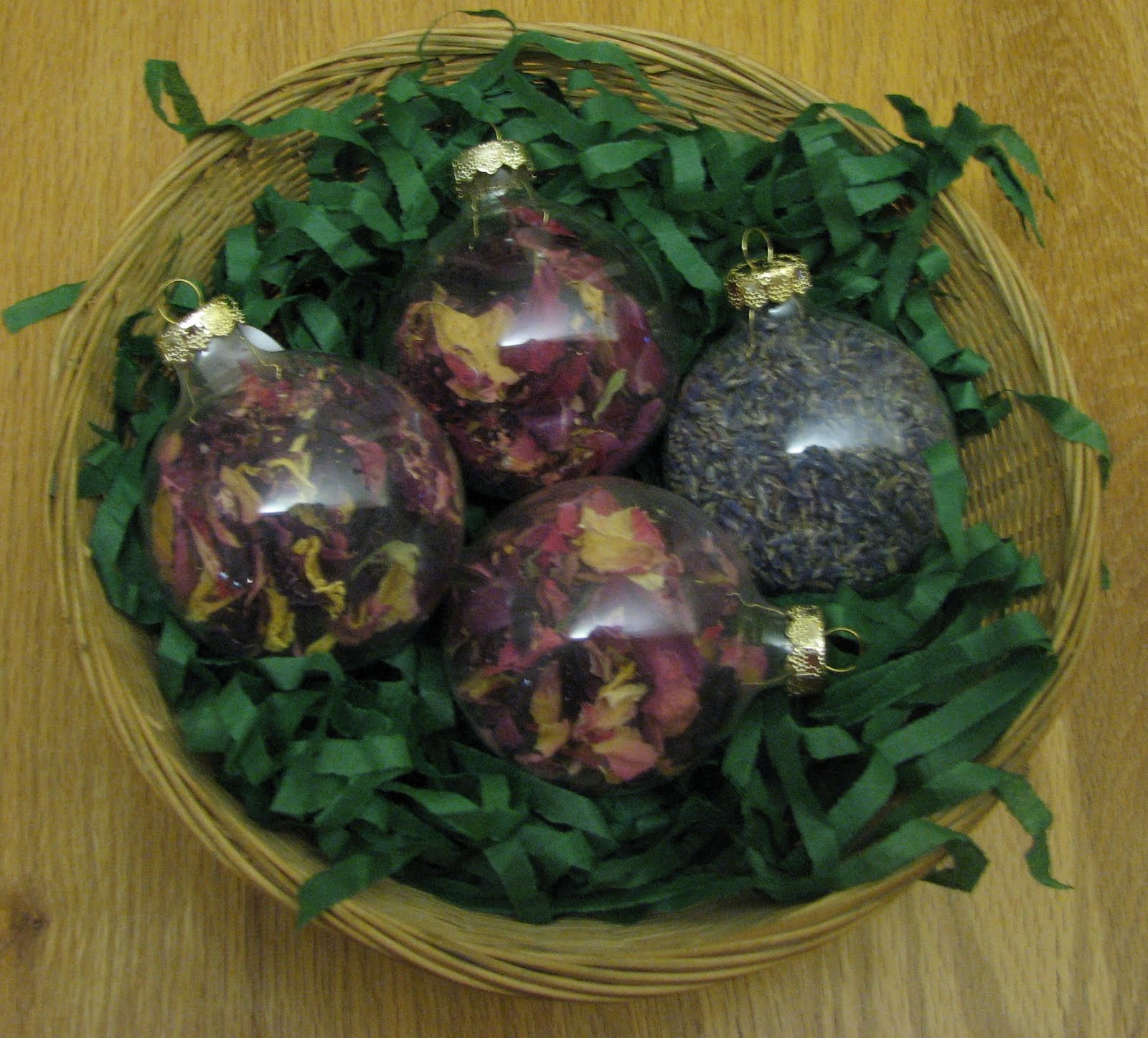
But the aesthetic project I will show you here is how to use them as a Christmas tree decoration. I purchase the very inexpensive, clear, empty, hard plastic ornaments and simply fill them with either lavender or rose petals or buds. It is an inexpensive yet beautiful way to use herbs and is a great winter reminder of the beauty of the garden. These last quite a few years and every year you can liven them up with a drop or two of essential oil dropped in the ornament. You can either hang these on your tree or simply put them in a bowl to view. Herbs that work well for this should be ones that retain their color and scent well and do not fall apart. Rosemary might be another herb that works well for this, although I've never tried it.

Here are some older posts you might enjoy that deal with crafts and aesthetics:
http://sagescript.blogspot.com/2009/01/scented-paper-valentines-day-project.html
http://sagescript.blogspot.com/2008/08/wedding-herbs.html
http://sagescript.blogspot.com/2008/05/mothers-day-tussie-mussie.html
I'd love to hear some of your ideas for using herbs aesthetically, please post them in the comments.

Sunday, November 29, 2009

Digging Echinacea


I dug up some echinacea roots a couple weeks ago. This is not only an important immune stimulating herb but also has antiviral activity making it an important herb for cold season. Although the active principles may be more concentrated in the roots, you can certainly find them in the leaves and flowers too. In the summer if I have flowers that break off I will just dry them and mix them with roots that I dig in the fall. I usually wait until the plant is 3 years old before using to be sure it has a good root system. Echinacea will reseed rather freely so I typically have several clumps growing in various places, so digging up one clump still leaves me with other clumps.
To do this, I use a shovel to dig up the roots, shake and break off the excess dirt and cut off the dead stems. I then bring the roots into the house and use a vegetable brush to clean the dirt from the roots; cutting some apart as necessary. I then let the root clump dry and will store it in a glass jar until needed. A coffee grinder can then be used to grind the roots into smaller pieces that can then be used to make tinctures or teas. Echinacea is an important part of my Thyma-Flu product.

Friday, November 20, 2009

Parabens and this and that


A quick blog today with some news and links.

A new report just came out on parabens that I found interesting. Having read previous papers about parabens I have been skeptical of the bad press they have received supposedly because of them affecting the hormonal systems of the body which lead to cancer. This new study indicates that although parabens are well absorbed orally they are poorly absorbed through the skin and are well metabolized before they reach the blood stream. And the metabolite found in the blood, p-hydroxybenzoic acid, had no hormone (estrogen) action in the body.

This study was presented by Florian Schellauf at the Scandinavian Society of Cosmetic Chemists (SCANCOS) in Sweden and has not yet been published in a peer reviewed journal, so I will wait before making any definite conclusions.

In fact, parabens themselves are natural substances found in food and so we are exposed to them through food. Parabens is the name given to a group of p-hydroxybenzoic acid (PHBA) esters. Parabens are biodegradable and natural. A growing number of manufacturers are now using Japanese honeysuckle extract in their products. This is a source of parabens and by using it the manufacturers are getting around the negative public perception of using parabens. We may have done parabens a big disservice and could find that they are actually the best and most natural preservative we can use. Lets keep an open mind on this. Here is more reading on the subject.


http://www.cosmeticsdesign.com/Formulation-Science/New-data-on-parabens-suggests-no-adverse-hormonal-effect-on-the-body

Here is another interesting article on parabens, a copy of a Paper on Natural Parabens by Anthony C. Dweck http://www.naturalingredient.org/Articles/toni1.html

http://www.ecomall.com/greenshopping/methylparaben.htm

Colorado Aromatics will be at the Cornucopia of Local Saturday November 21 and at the Winter Farmers Market at the Boulder County Fairgrounds Saturday, December 5.

http://www.boulderfarmers.org/longmont/longmont-about.htm


Check out Pamper yourself Denver's article about our natural spa gift sets:

http://www.pamperyourselfdenver.com/beauty-blog/great-holiday-gift-sets/

Friday, November 13, 2009

Holiday Gift Sets


For holiday shopping we are putting to together several body spa gift sets that would make perfect Holiday presents for family or friends. These sets are packed in “Inspired by Nature” gift boxes made from 100% recycled material. No need for extra wrapping paper so we encourage you to decrease the waste. Add a bow if you like.

Facial Spa Kit – With herbs for a steam facial, one ounce botanical toner (lavender/rose, lavender/lemon balm or cucumber/mint all distilled on our farm), parsley eye serum for those fine lines and dark circles under the eyes and a small guest size bar of face quality, handcrafted soap. $19.20

This would also pair nicely with our Springtide Antiaging face cream.

Hand Spa kit – With herbal soak for softening and cleansing hands, one ounce tin of knuckle balm for cuticle massage and other areas needing special attention, and a 4 oz jar of hand lotion (citrus or lavender), Also comes with a cuticle stick, emery board, and a small guest size bar of soap. $16.95

Pedi Paradise Foot Spa Kit – With herbal foot soak (relaxing and antifungal herbs), sugar scrub to soften rough spots and calluses and to finish off, Sole Pleasure Foot Butter in a 2 ounce push up container to moisturize and protect the feet, especially the heels. Also comes with a small, guest size bar of soap. $18.15

Any of these spa kits would pair well with a 40 gram bag of our loose leaf tea. All teas are organic teas from flavorful leaves, not the stale ground stuff found in teabags. We make the tea blends from herbs grown on our farm. Choose from Black Assam (orange pekoe), Rose Black (black with rose geranium and rose petals), Chunmee green tea, Lemon Green (green with lemon verbena and lemon balm). $4.00 each.

Lavender Lovers Gift Set – For lavender lovers only, includes a 4 oz bottle of Mountain Mist Hand and Body Lotion with Bulgarian Lavender essential oil, an 8 ml purse size mister of lavender hydrosol distilled on our farm, a bar of lavender soap with lavender buds from our farm and 2 dream pillow tea bags with lavender and other herbs to help you sleep; just slip it in your pillow case. $19.95.

You are also free to choose your own combination of products for your gift box as well. With every $30 or more order I will put it in an “Inspired by Nature” gift box made from 100% recycled material, along with tissue paper. Just put ‘gift’ in the box when checking out. Remember Colorado Aromatics products are all natural, botanical skin care products scientifically formulated and containing the best and most functional ingredients for your skin. You can buy any of these gift sets at Colorado Aromatics website: www.sagescript.com/products.htm. Happy Shopping.

Wednesday, November 4, 2009

Aromatic Toners


We are busy here getting some special products ready for the Holiday gift giving season. During the summer we distilled some wonderful herbs making aromatic waters. These distillates or hydrosols as they are sometimes called are great skin care products. They are rich in organic acids that help moisturize and keep the skin pH slightly acidic as it should be. This acid mantle is what helps protect the skin. They also contain microdroplets of essential oils making them wonderfully aromatic.

My favorite distillate of course is lavender or is it lemon balm, it’s hard to decide. I made three blends; lavender lemon balm, lavender rose, and cucumber mint all from herbs we grew on our farm this summer. These distillates alone are great to spray on the skin and face for hydration or to use as a body mist or spray in the hair before combing. I wanted to make them a little more special as a toner though so I added a small amount of glycerin as a humectant as well as extracts from raspberry leaf and plantago to soothe and tone the skin. I am selling these in both 1 ounce ($5.10) and 2 ounce ($7.70) spray bottles. You can also spray these on your neck and chest for toning, a place often overlooked when it comes to skin care. Products used in this area are sometimes refered to as décolleté products. The term also refers to a low neckline on a woman’s shirt and is certainly an area you want to look its best.

I love the feel of these toners on my skin and like the scents as a reminder of summer. All the ingredients were grown here on our farm. Distillates alone or with added ingredients are the best of natural skin care. These products can be purchased alone or as part of the gift bags I am putting together as well. These you will hear about soon.

Tuesday, October 27, 2009

Herbs for Winter Health

Echinacea
This is a good time of year to go over 'must-have' herbs for winter health. Since I am feeling "under the weather" today it also makes it a good time to review. Herbs that I have found most useful to treat and prevent colds and flu include elderberry, echinacea, thyme, sage and garlic. Infection is a combination of exposure to a critical number of bacteria or virus and the immune system not being able to handle the exposure. The herbs mentioned have both antiviral and antibacterial properties and several also have immune stimulating properties.

Elderberry is an important herb for flu and medical studies have found it to be effective. It contains neuraminidase activity, the same activity of the drug commonly used to treat the flu, Tamiflu. The best part is that elderberry tastes delicious. You can make a syrup from elderberry using these instructions. You can also make a liquor with elderberry by covering the elderberries with vodka, let set for two weeks and then add honey to taste. Alternatively, you can leave it with just vodka and use it as a tincture.

Thyme is a traditional herb used for bronchitis and upper respiratory tract infections. Thyme can be used in a number of ways; added directly to tea or make thyme honey to add to tea or use as a cough remedy.

Sage is a great herb to use for a sore throat. It too can be used to make a honey or as a tea itself. Echinacea is best used as a tincture; you can make this yourself (directions coming in another blog) or you can buy this. If you have Echinacea in your yard you want to harvest, this is the time of year to dig up the roots to make your tinctures; after the aerial parts of the plant have died back.

Garlic is a valuable herb that stimulates the immune system and has antiviral, antibacterial and antifungal activity. I like using garlic fresh as garlic toast. To do this first make a piece of toast from whole wheat bread. Then rub a garlic clove over the rough surface of the toast so that the garlic goes all over the surface of the toast. It may bite a little when you eat it, but it does great good!

For more information on what you can do for minor infections see my book "The Antibiotic Alternative". This month I am celebrating the 10th anniversary of its publication. You can see more about this book here.

Colorado Aromatics sells a product I call Thyma-Flu, a play on the drug name, Tamiflu. This product is a mix of immune stimulating herbs and antiviral herbs. You add drinking alcohol of your choice to the herbs to make a tincture. Take this at the first sign of cold or flu to prevent the symptoms from arising.
You can find this product here.

Thursday, October 22, 2009

Essential Oils and Aromatics, book review

Essential Oils and Aromatics: Step-by-Step Guide For Use in Massage and Aromatherapy
By Marge Clark
Silverleaf Press 2008


Marge Clark has recently been able to put some of her wisdom to paper in “Essential Oils and Aromatics: Step-by-Step Guide For Use in Massage and Aromatherapy”. This compact book is great for quick reference and filled with information. More than just a collection of essential oil monographs, this book starts with information on how to purchase essential oils and what to look for in an oil. It then continues to address the properties of carrier oils used for diluting the essential oils. Safety concerns are important to Marge and she addresses this as well.

You can of course find the typical information and blends for spa treatments, but this information goes much further. Aromatherapy is widely used for “mind and mood” and there are many suggestions for this use such as chamomile and jasmine for anger, or basil and clary sage for mental fatigue. Medical science has confirmed that many essential oils have antibacterial, antifungal or antiviral activities too. Marge’s recipe for a general germ killer blend takes this into account. The blend I am most interested in right now though is the tennis shoe freshener and am hoping that this might also work in my son’s gym bag!

You can purchase “Essential Oils and Aromatics” from her website at http://www.naturesgift.com/specbook.htm#Marges and she will autograph it if ordered from her. On her website http://www.naturesgift.com you can also find a large variety of essential oils, blends and carrier oils. One product of particular interest may be the “Flu Foil Synergy” which may be quite useful this flu season. I’d recommend this book to anyone interested in essential oils.


Friday, October 9, 2009

Protein Synthesis and the Nobel Prize

Proteins are by far the most important part of all cells. Their many functions include working as/in:
-enzymes that control all the chemical reactions that occur in the body
-immune function as antibodies
-cell membrane structure and carriers to regulate what goes in and out of a cell
-structural components of skin and muscle (eg. keratin, collagen, actin)
-cell communication in the form of hormones and other messengers.

Proteins are polymers of amino acids and are made in the cell on structural units called ribosomes. This year the Nobel Prize in chemistry was awarded to Ada Yonath of Israel, Thomas Steitz of the USA and Venkatraman Ramakrishnan of the UK for their work in understanding more about the structure and function of these ribosomes work that brings us closer to understanding how proteins are made.

The amino acid sequence of a protein is written in the DNA through various arrangements of four nucleotide bases (Watson and Crick received the Nobel Prize in 1962 for describing the structure of DNA). This code is then copied into the messenger RNA which carries it out of the nucleus to the ribosomes where the protein is made. Three consecutive bases code for one amino acid in the protein sequence. If a mistake is made by the ribosomes in reading this base code then there is a mistake in the protein itself which could prevent it from doing its job. Amazingly, ribosomes rarely make mistakes; only once per every 100,000 amino acids. This has to do with the structure of the ribosome and its ability to measure the distance between the transfer RNA (tRNA) which carries the amino acid and the codon in the messenger RNA (mRNA). Interestingly, the number of different arrangements that 4 nucleotides can arrange themselves in triplets is 64. Since there are only 20 amino acids that occur in protein (many more that don't occur in proteins) some triplet sequences code for the same amino acids while others signal a stop or start to protein synthesis.


This diagram shows two amino acids on the top. The R refers to a variety of side chains an amino acid can have to differentiate it from others. The bottom shows the two amino acids bonding together to make a peptide bond - to make a protein this step is repeated many times with additional amino acids.


This links describes the findings and the background regarding the 2009 Nobel Prize in Chemistry for describing the atomic structure of the ribosome.
http://nobelprize.org/nobel_prizes/chemistry/laureates/2009/info.pdf

Thyme Honey

With the herbs mostly harvested now its time to make sure our winter medicine cabinet has all it needs. Thyme honey is one of the important parts of our medicine cabinet. It is used for colds/flu and sore throats. Thyme has strong antiseptic properties including activity against viruses, insects, bacteria and fungus. Traditionally, thyme was used to treat bronchitis. I find it to be useful in our house for treating winter illnesses such as colds. One nice way to use thyme is as honey and its very easy to make. You can still pick thyme now, it should withstand a mild frost just fine. Cut stems short and put them in a glass jar. Cover the thyme with honey. Put the jar in a pan of water to slightly heat the honey while pushing the thyme down and adding more thyme. Once the honey is fluid, put the lid on the jar and store the honey with the thyme still in it until needed. You can use this honey to add to tea or use it straight for a sore throat.

Friday, October 2, 2009

Triglycerides and Skin Care


I thought I would do a series of blog entries on chemistry concepts that are important to the cosmetics crafter. Cosmetics crafters as well as herbalists come from diverse backgrounds often with no training in chemistry. If you are a cosmetic crafter or herbalist and have found that you could do alot more with some chemistry knowledge, then I hope my blog helps in your line of work. But before we get started, if you are planning on making your products ‘chemical free’ I suggest you think otherwise. Our bodies themselves are composed of chemicals and everything we put in or on our body is composed of chemicals. With some knowledge of chemistry we can find out which of these chemicals are safe, effective and actually good for us.
Lipids could be considered the most important part of skin care products. They are able to protect the skin from water loss, helping the barrier function of the skin. Lipids are defined by their ability to be soluble in organic solvents. In general lipids are used by mammals like us for energy reserves and to form cell membranes. The main lipid category is a triglyceride, also called a triacylglycerol. Other lipids include phospholipids, steroids and essential oils (for lack of any other category to put them). We’ll focus on the triglycerides alone though.
The structure of a triglyceride is a glycerol molecule as a backbone with three fatty acids attached to that. Since glycerol is a three carbon sugar, each fatty acid can bond to one of the carbons. Glycerine is also an alcohol as defined by the –OH groups.

Glycerin

Below is a triglyceride. You can see the three carbon glycerin portion of the molecule on the left and the fatty acid chains to the right. Using this type of connotation each bend of the line represents a carbon atom.
Triglyceride

Fatty acids are long chain hydrocarbons and identified by the number of carbons in their chain as well as by the number and placement of double bonds.
In this figure the first fatty acid from the top has16 carbons with no double bond. This fatty is abbreviated 16:0 and called palmitic acid. This fatty acid is saturated meaning that there are no double bonds in the chain. Each carbon atom is bonded to two hydrogen atoms (not shown) so the carbons are saturated with hydrogens.
The second fatty acid from the top has 18 carbons and one double bond. This is abbreviated 18:1 and is called oleic acid. Notice too that the double bond is at the ninth carbon.
The third fatty acid chain has 18 carbons again but three double bonds. This is abbreviated 18:3 and is refered to as alpha linolenic acid. This is an omega-3 fatty acid which refers to the fact that it has a double bond 3 carbons from the omega end of the chain.
So each different oil or fat you use in skin care is made up of triglycerides. Triglycerides found in different oils have different fatty acids associated with them which is referred to as the fatty acid profile. Various fatty acids can have different properties for skin care, a topic for another blog.

Thursday, September 24, 2009

Herb Drying Rack

This time of year my workshop is taken over with herbs that are drying everywhere so I've been trying to come up with more compact ways of drying them. Here is one of them.
I took an old cloths drying rack that was actually broken and glued it back together. Unfortunately, this means it is no longer collapsible, but that is ok. By setting it up I am able to put a screen across the top as well as the bottom rods. Now I can lay herbs across these screens and they have plenty of airflow from above and below. I could also tie bundles of herbs to the rods. You can see I also have a grass woven bag hanging from the rack. The open weave of this bag allows airflow and I can have dry herbs inside of that as well.
In addition to this I have a few hooks on the backside of my bookshelves to hang herbs from as well as hooks under a cupboard.
Do you have any space saving ideas for drying herbs?

Sunday, September 20, 2009

Simply Super Tomatoes


Here is a recipe that my Mom used to make alot that I just love. We had this tomato dish this week.
Simply Super Tomatoes
Dressing
2/3 cup oilive oil
1/4 cup red wine vinegar
1/4 cup finely chopped chives
1/4 cup finely chopped fresh parsley
1-2 cloves of garlic crushed and minced
1 teaspoon chopped dill weed
2 teaspoons chopped, fresh basil
1 tsp salt
1/4 tsp ground pepper
shake this together and pour over 6- 8 fresh tomatoes sliced.
Enjoy

We've grown quite a few different tomatoes this summer but the one's that have really taken off are the cherry tomatoes. Unfortunately, we did not do a good job at staking them and they are laying on the ground alot. One winter project will be to build sturdy tomato cages.

The weather here is becoming a bit chillier and tomorrow night may dip close to freezing. We will keep a close watch on it and pick and cover where necessary. Although I've been able to cut quite a bit of calendula from my garden to use in products over the winter, Jason at Aspen Moon Organic Farm has allowed me to pick some of the calendula from his farm as well. Its nice to be well stocked with this important herb.

Thursday, September 10, 2009

Harvest Pizza

I love going out to the garden in the afternoon and deciding what to make for dinner when I see what is out there. This week we had a harvest pizza that was loaded with zucchini, fresh onion, and lots of roma tomatoes. Its good to have a basic pizza crust recipe because this can be used for a number of things including frittata. Here is my recipe:
2 1/2 cups warm water
2 tablespoons yeast
3 cups white flour
3 cups whole wheat flour
1 tablespoon honey
1 tablespoon olive oil
3/4 teaspoons salt
First mix the water and yeast together, then add the rest and mix. Let rise in a warm place for 1 hour or so (times are only a guideline). Knead, split in two (or more) and roll dough out on a floured surface to the size/shape pizza you want. Top as you wish!
I made this dough one time and covered it with onions that had been stir fried and topped that with feta cheese and herbs. Yum!
Wish I'd remembered to take a picture. But try going out to your garden to find something to top a pizza crust with. Let me know what you find.

Friday, September 4, 2009

15 Flowers/Herbs in 15 Minutes

As I was thinking of what to blog about I was glad to see I was tagged for this exercise which sounded fun. Rules: Don't take too long to think about it. Fifteen flowers or herbs you've worked with or been touched by that will always stick with you. You don't have to have used the plant medicinally (heck, you don't even have to like it), you just have to have been deeply impacted by it in some way. First fifteen you can recall in no more than fifteen minutes.

1. Daisy – this was my Mothers favorite flower

2. Lilac – I love the smell. I fell in love with lilacs as a young child, we had one near our back door.

3. Rose – The thorny beauty, a beautiful flower and a beautiful smell.

4. Lavender – has been one of my favorite herbs for its aroma, appearance and hardiness. I have planted significant numbers of lavender here on our farm.

4. Calendula – a medicinal flower that has become an important part of many of my skin care products.

5. Chamomile – first loved this from Celestial Seasonings Sleepy Time tea, well actually before that in Mo’s 24. I now grow it and distill it for its anti-inflammatory and soothing properties.

6. Rosemary – although it never blooms in my climate when I once saw a rosemary bush in full bloom it was quite impressive. I use rosemary extract for its antioxidants.

7. Grass – Since I live on the prairie grass flowers are common. Very unobtrusive yet most grasses can only be identified by their flower. Of course many grasses such as wheat are used as food and having a pasture I need to pay attention to what grasses are there.

8. Strawberry – again, a small flower but I know that each of those flowers will yield a juicy fruit.

9. Lemon balm – I love how eager it is to grow and use it in many of my products as well as distill it.

10. Basil – its spicy taste has to be my favorite. Recently I am learning of other varieties of basil as well as its medicinal benefits in helping with stress.

11. Echinacea – a beautiful, easy to grow flower and a must when it comes to cold/flu prevention. A picture of this flower also graced the cover of my book “The Antibiotic Alternative”

12. Hollyhocks – I was pleased to see this flower coming up in the garden at my first house. I love its tall stature in the garden and its old fashioned appearance.

13. Yarrow – this is native here in the west so it is easy to grow and it has great medicinal properties.

14. Linden – the aroma of the Linden tree flower is overwhelming in the spring and certainly brightens a mood.

15. Pine – I love the peacefulness of being in a pine forest. The aroma reminds me of living in Flagstaff, Arizona. These trees also remind me of this song we sang in Girl Scouts called Canadian Wilderness:

Smoke rising from the fire
Up through the trees in a stately spire
All is well as evening lows
Sun goes down as north wind blows

Wednesday, August 26, 2009

Garden Pictures for Wordless Wed

This time of year is when all the hard work pays off and we are harvesting all we can. Here are some tomatoes rippening on the vine, a large zucchini plant, purple sage, echinacea, and of course Longs and Meeker Peaks that we enjoy seeing almost everyday. I hope you too are enjoying this time of year.


Thursday, August 20, 2009

ChokeCherry Find

My husband came home from work with a bagful of chokecherries he picked so we had to figure out something to do with them. The most obvious use of chokecherry is as a syrup to be used in the winter for coughs (as well as being delicious on ice cream, pancakes, drinks or anywhere else you would use a syrup). Typically choke cherries are very bitter and astringent in taste, but these are actually very sweet; possibly because they were growing by a stream and getting more water. Chokecherries are very high in ellagic acid. Since I have been reading lately of the benefits of ellagic acid in skin care I wanted to find some use for these fruits for skin, perhaps a face mask.


Face Mask

Mix

3 tablespoons chokecherry juice

1 tablespoon bentonite clay

2 teaspoons avocado oil

Mix to a nice consistency and smear on your face. Now enjoy a cup of tea while the mask sets on your face. After 10 minutes or so use a wet washcloth to wipe the mask off your face.


Chokecherry Juice

To make a juice put chokecherries in a saucepan to fill about 2/3 full. Fill with water almost to the level of the top of the cherries. Bring water to a gentle boil for 30 minutes or so. Put cherries through some type of press such as used to make jam. I use a device used to make applesauce. Allow juice to drain into a separate bowl while skins and seeds remain behind.


Chokecherry Syrup

For chokecherry syrup I mixed 3 cups of juice with about 3 cups of sugar and simmered that for about 30 minutes. This produced a very thick syrup that would work great for pancakes. For a cough syrup I will use 3 cups of juice with 1 1/2 sugar and also add a few tablespoons of vodka to that as well. The lower amount of sugar might not be enough of a preservative. You could also freeze this until you want to use it.


The seeds however contain poisonous glycosides (hydrocyanic acid) and should not be eaten by humans or animals; unless cooked or dried first.


Chokecherries are native to much of the US and were used extensively by Native Americans for a number of health complaints. These include as a poultice to stop bleeding and to treat skin sores and burns, as a tea or infusion for stomach cramps, fever, diarrhea and dysentery. Both the fruit and the bark are used medicinally. The cherries also a a good food source for both humans and animals. Chokecherry jam and pies are quite common and chokecherries were an important ingredient of the pemmican made by many Native Americans as a dried food for winter.


The purple color of the cherries is said to make a good purple-red dye. This is something I might save some berries for to try dying some mohair. Last summer I planted quite a few chokecherry bushes so by next summer I may be loaded with cherries.

Here is a good write up on chokecherries for more information.

http://plants.usda.gov/plantguide/doc/cs_prvi.doc


LinkWithin

Related Posts with Thumbnails