Showing posts with label rosemary. Show all posts

Wednesday, July 16, 2014

Five Herbs to Fight Cancer


Best Herbs for Health and Fighting Cancer


Parsley


1. Rosemary – Contains many antioxidants such as carnosol. Antioxidants help prevent DNA damage leading to cancer. Carnosol and cineole may also help to detoxify certain carcinogens that can initiate the cancer process, especially breast, skin and lung. It is also great for the hair as a rinse and great in skin care to increase circulation. Use in soups, stews, meat or vegetables and bread.

3.  Oregano - Contains farnesol, a phytochemical that has been shown to block the growth of skin cancer in mice. Also contains quercetin, an antioxidant, which may be protective against breast, ovarian and endometrial cancers. This herb is greatin Mexican or Italian dishes with chili, garlic, tomatoes and onions (all of which also have their own health benefits).

4. Ginger - The pungency in this herb is due to gingerol. When dried, zingerone is formed. Both have antioxidant and anti-inflammatory effects. They are believed to suppress the growth of cancer cells by inducing cell death. This herb is used fresh in many Asian dishes. This makes a great tea when you are feeling under the weather too.

5. Parsley - Rich in polyacetylenes, which seem to protect against certain carcinogens found in tobacco smoke. It may also help to regulate the body's production of some prostaglandins which can be tumor promotors. Parsley is great in any salad and with tomatoes.

6. Mint – Contains limonene which is also found in citrus peels, cherries, and lavender. Studies suggest that this phytochemical can block the development of breast tumors and shrink them. Limonene is currently being used in clinical trials for the treatment of cancer. My favorite use of mint is a mojito!

7. Turmeric - Contains the yellow pigment curcumin. Curcumin is a good anti-inflammatory agent and can block cell proliferation in the colon that results in colon polyps and possibly colon cancer. In cell culture studies, curcumin has slowed the proliferation of prostate cancer cells. Curcumin can also help with inflammatory diseases like arthritis.
 

Wednesday, September 28, 2011

Brewers Herbs

Beer is an ancient drink (and food) that I happen to be quite fond of. I especially like beer with lots of floral hops. Hops were not always used in beer though, and may not have been used until the 9th century. Before that, a mixture of herbs referred to as gruit was used to flavor beer. Although I don't brew beer, I do grow hops and other herbs so am interested in what herbs are used in beer. I recently read "The Homebrewer's Garden" by Joe and Dennis Fisher to learn more about herbs in brewing, a very interesting book by the way.

Here are some of the herbs from this book that grow in my gardens.

Anise Hyssop - provides a licorice flavor to beer.
Basil - adds a slightly bitter, spicy flavor.
Bee Balm - often used as a tea, bee  balm provides a bitter, minty flavor.
Borage - gives a spicy, cucumber like flavor to beer. This herb can also be steeped in wine.
Chamomile (Roman) - is said to be one of the 'secret' herbs in Celis White beer. It gives an apple-like flavoring.
Clary Sage - provides a balsamlike aroma to beer.
Coriander - this is a flavoring in one of my favorite beers; Belgian Whites.
Dandelion - yet another use for this common weed. Use the tender spring leaves in your salad and the larger leaves later in the season to bitter your beer.
Elder - the berries are best know for making wine, but they can also be used to flavor beer. The flowers can be used for 'dry hopping' as well.
Oregano - adds a distinctive flavor to beer.

Horehound - this herb can add a warm, menthol flavor. I wonder if horehound beer can be used to control coughs?
Hyssop officinalis - this herb is used in Benedictine and Chartreuse. Using it in beer provides a minty, medicinal scent.
Juniper - commonly used in gin, juniper can contribute this taste to beer as well.
Lavender - oh, the many uses of sweet lavender. I would love to try a pale ale flavored with lavender. Let me know if you know of one.
Lemon Balm - this is used in many liquours and can add a lemon scent/flavor to beer.
Mint - there are many types of  mint, and although I love a mint tea, I don't know how this would be in beer.
Rhubarb - great in a fruit crisp, this is one fruit that would be interesting in beer.
Rose hips - apparently rose hips are used in some beers from Poland and impart a citrus flavor and red color to beer.
Rosemary - before the use of hops in beer, rosemary was quite popular.
Sage - was used in fifteenth century English beer recipes and adds bitterness and camphorlike scent.
Savory, Summer - provide a peppery, oregano-like flavor and aroma.
Spruce - was popular during the American Revolution spruce adds distinct, woods taste that is popular in winter beers.
Sweet Woodruff - this herb is what makes May wine what it is but can also be used to add a mild, sweet aroma to beer.
Thyme - used to give beer a spicy aroma.
Valerian root - is commonly used as a sedative so what better place to use it than beer?
Yarrow - both the leaves and flowers can be used to bitter beer.

I'd love to see more 'herbal' beers so I hope that if you are a brewer this gives you some ideas - and don't hesitate to share with me! I'd love to write reviews!

Friday, April 22, 2011

Herbal Spunk Shampoo


Our customers said they wanted an all natural shampoo with gentle surfactants and now we've got one. As always, we started with beneficial herbs. We choose southernwood, sage, horsetail, green tea and catnip to improve hair growth, strength and shine. Peppermint and rosemary help improve blood circulation to the scalp which also contributes to healthier hair follicles and better hair growth. Panthenol, a B vitamin, binds to the hair shaft to seal it and improve shine. Along with glycerin and aloe, panthenol moisturizes the hair and scalp.

This shampoo also contains very good conditioners including a guar gum derivative to leave hair soft, shiny, easy to comb and will protect color treated hair. You won't need to use a separate conditioner afterward.

The gentle surfactants in this shampoo will not strip the hair or dry the scalp.

We think you will love this shampoo. Try it and tell us what you think.
http://sagescript.com/bathandshower.htm

Ingredients:
water, decyl glucoside, sodium lauroyl lactylate, aloe barbadensis leaf juice, glycerin, panthenol, camellia sinensis (green tea) extract, guar hydroxypropyltrimonium chloride, benzyl alcohol, dehydroacetic acid, artemisia abrotanum (Southernwood), extract, salvia officinalis (sage) extract, mentha piperita (peppermint) extract, Nepeta cataria (catnip) extract, rosmarinis officinalis.

Thursday, February 17, 2011

A Fairy Garden


I get anxious for spring this time of year so I made a visit to my local garden center. After seeing some of the adorable fairy gardens on display I decided making my own would be a great way to get through the rest of winter. I knew my fairy garden needed to be made from herbs alone. I choose Roman Chamomile, Gota kola, Thyme, Rose Geranium, and Rosemary, all have great aromas and textures. Some of these plants were pretty dense so I split them as I transplanted them into the wide clay pot I purchased. I'll save the part I split off to put in the garden in spring. As the herbs grow I will trim them so they will get denser. The rosemary and thyme will eventually hang over the side of the clay pot I hope. The rose geranium I trimmed quite a bit around the bottom so that it would look more like a tree and provide a shady place for the fairies to sit. The garden center had quite a few ceramic fairies and other 'paraphernalia' to choose from so if you decide to design a fairy garden be sure to get a pot big enough to fit all the fun options you'll want. But just looking at the miniature garden items; shovels, wheelbarrows, fences, chairs etc. was alot of fun in itself.

After filling the pot with soil I put a path down the middle made from crushed oyster shell. This was something we already had on hand for our chickens but you can find several bags of crushed stones at the garden center too. The fairies then went in right under the rose geranium tree where they seem to be comfortable. I found a frog outside that had broken off a globe in the garden and he wanted to be part of the garden too and talk with the fairies so he went in too; even though his size seems to be a bit out of proportion!
What do you do to help get through the last part of winter?

Monday, December 13, 2010

Do You Saponify?


Do you saponify? Some of my best friends do. And although it can be quite dangerous without proper precautions and can be addicting, it is still good clean fun. I am proud to be a professional soapmaker and keep company with other soapmakers; they are among the nicest people I know!

Saponification is the base promoted hydroysis of an ester to produce an alcohol and the sodium salt of that acid. What?? OK, lets break it down. The ester used in soapmaking is a triglyceride, also called a triacylglyerol. This is a type of fat consisting of a glycerol (3 carbon sugar) which is attached to 3 fatty acids through a ester bond. The fatty acids in the picture are the 3 tails sticking out to the left and the glycerol is the 3 carbon backbone running vertically on the right. There are many different types of fatty acids and the three fatty acids found in any triglyceride will vary. The ester bonds are between the O (oxygen) on the glycerol and the C=O on the fatty acid.

When soap is made this bond between the fatty acids and glycerol is broken by the presence of a strong base or alkali, this means something with a very high pH. This strong base is sodium hydroxide (NaOH). Yes, it is drain cleaner and a very dangerous substance when not handled properly. We soapmakers take proper precautions. And just to make sure you keep reading, I will tell you now that finished soap is completely safe because there is no lye left in the soap when done properly. We know alot today about this chemical reaction and can actually calculate the precise amount of lye necessary to react with various oils. Soapmakers generally use online calculators to determine the exact amount of lye to use in their individual recipe and then add little bit more oil to 'superfat' the soap making it more mild. Previous generations did not have this so many of 'Grandma's' soaps came out heavy on the lye and were quite harsh. Today handcrafted soaps are very mild and the soapmaker can vary characteristics of the soap by using different triglycerides or oils.

OK, back to the saponification reaction. The NaOH breaks the ester bond between the glycerol and fatty acids. The -OH (hydroxide) part of the NaOH chemically or covalently binds to the glycerol side while the Na (sodium) chemically binds to the fatty acids. Now instead of a triglyceride we have a free glycerol molecule and a sodium (Na) salt of the fatty acid. Wow! Chemistry in action. Small soapmakers will leave the glycerol (also called glycerin) in the soap and it makes a great moisturizer. Some large companies will remove the glycerin to use for other purposes. If you've never tried a bar of handcrafted soap, you don't know what you are missing. These are generally very mild and moisturizing cleansers compared to grocery store big brands, most of which are technically not soap.

Everybody makes soaps a little differently. Some people go for the latest bath and body scents, others go for the visual effect and make beautiful works of art from their soap. Being an herbalist, I am always looking for herbs that can benefit a bar of soap. Some of my favorites for soap include calendula, mint, lavender, rosemary.

While soapmaking has been around for sometime it recently has boomed as a cottage industry and soapmakers even have their own professional organization; the Handcrafted Soapmakers Guild. If you are interested in soapmaking visit there to find out more. You can also find soapmakers there but you can also find plenty of handcrafted soap on my website. What is your favorite kind of soap?


Sunday, May 16, 2010

Using Herbs in Skin Care - an Interview


I was recently interviewed by Beth Byrne about using botanicals in soaps for an article in The Saponifier. This is a summary of that interview.


1. Name, location, business name, any other background info.

My name is Cindy Jones. My business name is Sagescript Institute and I've recently started calling my line of products "Colorado Aromatics". We moved to a 9 acre property in Longmont CO (45 min north of Denver) almost 3 years ago after spending several years on a large lot in one of Denver's older suburbs. It was my love of herbs that played a big role in my interest in skin care products. It started off as a hobby making products for friends and family and eventually grew into a business when I realized it really encompassed most of my loves including chemistry and physiology.

2. What are some of the botanicals you use most in soapmaking?
Calendula is my favorite and I use it in soap to give a nice color. I use the petals either whole or ground added at trace. Calendula is a wonderful herb that contains a variety of carotenoids. Calendula has been found to improve wound healing so is great for regenerating epithelial cells of the skin. The calendula soap I make also has oatmeal in it and customers have told me it helps their eczema. It makes a very mild soap. Other herbs I use in soap include mint, rosemary, lavender and rosehips. Actually I also just made a chocolate soap with choke cherry skins in it, sort of a Black Forest Soap! I love thinking of herbs to put in soap.

3. Why do you use them?
The main reason I use herbs is because I love them and love growing them! My business has evolved as an agricultural business and to be part of my local farmers market requires that my products be agricultural and so they all contain herbs that I grow. Since herbs have many beneficial properties for skin this has been easy. Of course the benefits of herbs in a wash off product like soap is not going to be as much as a leave on product. But the idea of herbs in soap is definitely aesthetically pleasing and we all know that is important with skin care. Herbs are high in antioxidant flavonoids which are water soluble and extracted in a tea. Flavonoids are stable in high pH like lye so their benefits should come through in a soap. You can use a tea to replace any or all of the water in your soap. Ground herbs used in soap is slightly exfoliating.


Extracts of herbs can also be used in leave on products where they provide more benefits. I sometimes use tinctures because that way I know any microbials have been destroyed. Green tea and rosemary are two that I use frequently as tinctures. Infused oils and water extracts can also be used. When using herbs in skin care though its important to remember that whatever is good for your skin is also good for bacterial or fungal growth so preservation is important. And of course, you know that microbiology testing is another thing Sagescript does!

4. Where do you get your botanicals?
The reason we moved to our farm was so that we could grow plenty of herbs. I am working towards growing all my own herbs but am not there yet. It takes a few years to get good growth on many herbs so patience is important. I am also limited by the amount of time and energy I have and trying to fit everything else in. I grow calendula, mint, comfrey, yarrow, lemon balm, clary sage, plantago, parsely, lavender, fennel, feverfew, sage, thyme, oregano, rose, artemisia, raspberry, rosemary, prunella, hops, chamomile, and others I'm sure I've forgotten. I also grow rose geranium but not alot since it is one that has to go in my sunroom/shed/greenhouse during the winter. I also use these herbs to distill. I love to use the aromatic distillates alone or with added herbs as a toner or haircare product, or in a lotion/cream. When I don't have enough of something I first search for someone local who will let me harvest and if that doesn't work I purchase it from a supplier.


Information from this interview (and others) was published in the May/June 2010 issue of The Saponifier in the article "How You Can Use Botanicals in Soap and Cosmetics" by Beth Byrne.

Wednesday, April 28, 2010

The Farm in Spring


Colorado had a long cold winter with lots of snow and a good amount of rain in April. With temperatures gradually warming the gardens should do well this summer as long as we can keep them watered during the heat of summer. Chives, clary sage, mint, parsley as well as hops and southernwood are all growing well so far.


Over the winter I have gone over what herbs I used the most of and what I need more of. This summer I will find more room for calendula. I probably use calendula more than any other herb in my products. It is high in carotenoids which help skin cells grow to promote wound healing and help replenish epithelial cells. This is always important but becomes more so as we age. I’ll need more calendula for my own products as well as with hopes of selling calendula extracts this summer. I will also be offering green tea extracts, rosemary extracts, plantain, red clover and raspberry extracts for those interested in using them in products. They are all very good herbs for skin care.


Mint is also low but I know that just being one year older will make a big difference in how abundant their stems are. I make a mint infused oil to use in many of my products as mint helps to soften the skin and leaves a nice feel. I’ll be putting in more lavender of course, probably one to two more rows and then have to decide if I want to dig up pasture for additional lavender. Perhaps another rose bush, but again, with one more year’s growth my roses should be flourishing this summer. I choose my roses based on having high fragrance. I use ground rose petals in soap, salt scrub and facial steams and would like to have enough to distill for the aromatic water. I also make infused oil from rose petals that I think will be an ingredient in my olive oil cleanser.


Much of my time right now is taken up in getting products ready for the Farmers Market. Summer of course is busy for all gardeners and sometimes its hard to find enough time for anything else. Having a high number of products at the beginning of the summer makes it easier to fit in time for weeding, watering, planting, harvesting and drying. I may have to look for help this summer in the form of an apprentice who will trade work for learning experience. If you are interested or know someone who is please point them in my direction.


Besides planning for this year’s plantings I like to go through what dried herbs I have from last year and use up what I have leftover. One fun way to use up these herbs is to do a steam facial. Almost any herbs will work for this but rose, lavender, fennel and mint are especially good for a steam facial. Put a handful of dried herbs in a bowl and pour boiling water over it. Hold your head over the bowl with a towel over your head to help hold in the steam. Let the steam rise to your skin to hydrate, clean your pores and relax your body. What herbs do you have to use up before you harvest this summer?

Tuesday, December 1, 2009

Herbal Aesthetics - Tree Ornament


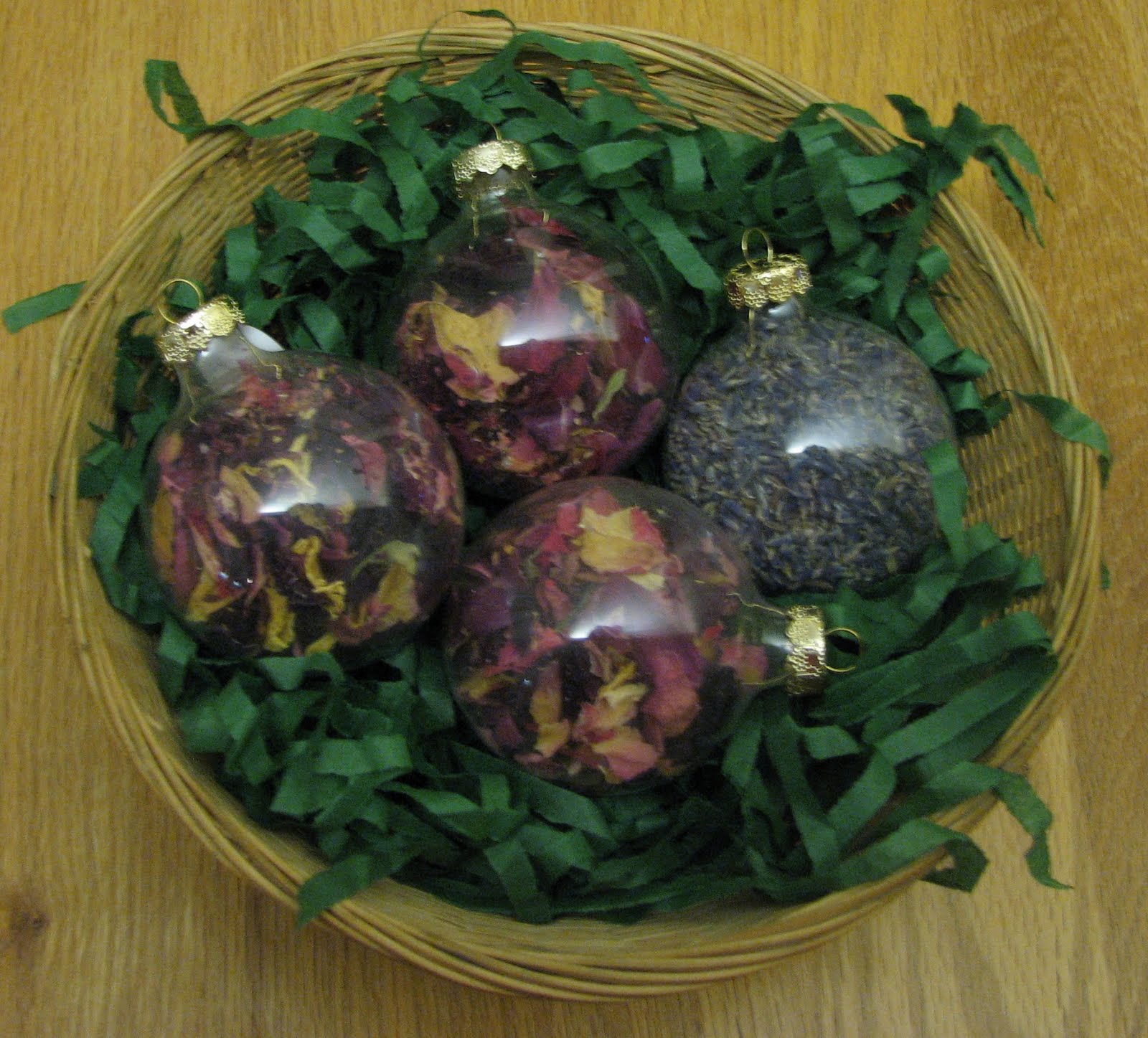
Herbs are full of aesthetic properties that include color, texture and fragrance. It is a joy to find different ways to use them. If you love using herbs you are in luck because Cory Trusty at Aquarian Bath is hosting a blog party this month based on Herbal Aesthetics. So after you spend some time here, go over there to see the other blogs participating in this topic.

I don't consider myself a 'crafty' person so crafts that I do have to be simple, so that is what you will find here. Two of my favorite herbs are rose and lavender. They have amazing fragrances as well as textures. Lavender flowers are tiny flowers that range in color from gray to dark blue. Roses start as small buds and then blossom into large petaled flowers with colors that include yellow, pink, and red. All summer long I dry as many roses and lavender stems as I can. With roses I dry both the whole flowers and the small buds. I look forward to spending time with these herbs in the winter after the growing season ends.

A small bowl of dried lavender and rose buds looks beautiful in a bathroom. A drop or two of essential oil can add to the pleasure. Because both of these herbs are also good skin care herbs I use crumbled rose petals and lavender buds in a number of skin care products such as bath salts and scrubs. I also distill both of them for their aromatic waters or hydrosols.

But the aesthetic project I will show you here is how to use them as a Christmas tree decoration. I purchase the very inexpensive, clear, empty, hard plastic ornaments and simply fill them with either lavender or rose petals or buds. It is an inexpensive yet beautiful way to use herbs and is a great winter reminder of the beauty of the garden. These last quite a few years and every year you can liven them up with a drop or two of essential oil dropped in the ornament. You can either hang these on your tree or simply put them in a bowl to view. Herbs that work well for this should be ones that retain their color and scent well and do not fall apart. Rosemary might be another herb that works well for this, although I've never tried it.

Here are some older posts you might enjoy that deal with crafts and aesthetics:
http://sagescript.blogspot.com/2009/01/scented-paper-valentines-day-project.html
http://sagescript.blogspot.com/2008/08/wedding-herbs.html
http://sagescript.blogspot.com/2008/05/mothers-day-tussie-mussie.html
I'd love to hear some of your ideas for using herbs aesthetically, please post them in the comments.

Wednesday, December 17, 2008

Cold in the Greenhouse


When I got home from a trip Monday night the temperatures were in the negative! The next day I noticed some of my rose geraniums in the greenhouse had gotten nipped by the cold. Mind you, this is not really a greenhouse; it has no temperature controls. It is basically a shed with a brick floor, south facing windows and a large water container inside and my workshop on the other side. I was told by the previous owners that it never froze inside, but temps below zero may have pushed things. One of my rose geraniums is severely drooping right now but I am hopeful that it can recover. You can see another rose geranium looks pretty good as does the rosemary and lemon verbena. The common geranium is also blooming red which is great for the Holidays. I use this greenhouse for overwintering some of my plants and am trying my hand at starting some new plants as well; mint and lavender. I also have a try of mixed lettuces going which I will harvest from soon. Its nice to have fresh greens in the middle of winter for a salad. I am also housing some tender plants from the Herb Society garden. Some of these are not doing too well as I think not enough roots came with them upon transplant. They include stevia, lemon grass, bay, marjoram and a few others. If I remember correctly, the garden cleanup day was a cold and wet one and these were probably dug in haste! But, its always hard to predict Mother Nature and even they may come back.

Tuesday, November 11, 2008

Springtide Anti-Aging Cream


I'm introducing the new anti-aging cream that I have been working on for some time. Now I have a formula that am very happy with. This cream contains natural, botanical, safe, and effective ingredients. Green tea and rosemary extracts are the primary herbs in this cream and give it a beautiful, pale green color. A touch of peppermint essential oil blends well with the scent of rosemary extract and gives the cream a refreshing feel.

Green tea and rosemary can be considered cosmeceuticals because of the active phytochemicals tbey contain. Green tea is a remarkable plant that has a multitude of health benefits. As far as skin benefits, phytochemicals in tea absorb UV light and so decrease the risk of sun damage to the skin. Sun damage includes redness, DNA damage, collagen degradation and formation of free radicals. It has also been found in animal studies to decrease the risk of skin cancer both when applied topically and when taken internally. It appears that besides the catechins found in tea, the caffeine is also important for this activity.

Rosemary extract has anti-cancer activity in animals possibly due to potent anti-oxidant activity. In fact, rosemary extract has been shown to be particularly useful in preventing oxidation of skin lipids that are important for helpin the skin stay moist. This is partially due to its high content of polyphenols (flavonoids) such as carnosic acid, rosmarinic acid, caffeic acid and ursolic acid.

Besides the nourishing vegetable oils and distilled fennel extract in this cream it also contains alpha-lipoic acid and vitamin C ester; both powerful antioxidants. I wish I could bath in it! You can purchase this anti-aging cream now for $11.95 plus postage. The price will go up after the New Year. I am confident you will enjoy using this cream on your face as well as the back of your hands. Oh, I have named this cream 'Springtide' to represent its youthful effect on the skin. email me for ordering information. sagescript@ earthlink.net


Wednesday, October 29, 2008

Herbs for Halloween - What is in that bubbling cauldron?

I grew the large pumpkin on the right, my neighbor gifted me the one on the left. Notice the small turnip on the left too.


I’ve always liked Halloween. Perhaps it’s because I like being someone I am not or because I am glad for the changing seasons and the tendency towards inward focus. As are most holidays, Halloween involves a blend of Christian and Pagan rituals. The Christian holiday is All Saints Day and All Souls Day when Christians celebrate and honor their dead. The Pagan holiday is Samhain or the Celtic Feast of the Dead and the Celtic new year. On Halloween night it is said the veil between the worlds of the living and dead is lifted and spirits are able to visit the earth. Because of this inherent danger many rituals have developed to protect oneself from any spirit that may mean harm. The foremost ritual being wearing a costume or camouflage of sorts so as to not be recognized.

My favorite herb of Halloween is Calendula or Mary’s Gold used to honor the Virgin Mary. It is a protective herb and is used in the Mexican tradition of Dia de los Muertos. Calendula with its bright, sunny appearance is placed either on a home altar or at the cemetery to help a deceased loved one find their way to living family members. Calendula also symbolizes grief that we may feel. Since Calendula is not native to Mexico, it is likely one of the Tagetes species was traditionally used as ‘marigold’.

Apples symbolize Halloween as they ripen this time of year. They are a symbol of love and fertility. It is said that the first girl to be able to bite an apple while bobbing would marry during the coming year.

Pumpkin is probably the most used symbol of Halloween. Although there are many stories about the jack-o’lantern the one I like goes like this:

Jack was a stingy, greedy man who was also fond of playing tricks on the devil. The devil’s revenge was to condemn Jack to walk the earth with only a lantern for light until Judgment day. In Ireland this lantern was made in a turnip, but the tradition changed to a pumpkin in the US because their larger size was more desirable. I grew turnips this year and might give the turnip lantern a try.

Many of the herbs were used during the Halloween season in the Middle Ages for protection and to cast away evil spirits. Among these are:
• Juniper which can be laid at the front door to deter witches and bad spirits.
• Rue, once called the “herb of grace of Sundays” was hung from doorways to ward off witches and spells. It was also used as protection from the plague during the Middle Ages. Branches of rue were sometimes used to sprinkle holy water in the Catholic Mass, now pine branch is the preferred method.
• St. John’s wort was hung at windows to keep evil spirits from entering the house.
• Rosemary, so called because it is the “Rose of Mary” was put over the cradle of babies for protection as well as under pillows.

Belladonna (Atropa belladonna) was said to be used as a ‘flying ointment’ by some. An extract of this herb absorbed through the skin gave the user a feeling of flying or astral projection. This herb however can be deadly and should not be used.

My Halloweens of the past 17 years have consisted of trick or treating with my children. I love trick or treating as it seems a good 'neighborhood' ritual; time to check in with neighbors for a short chat before everyone closes themselves in for the winter. I also typically have a fire in the grill and let the kids cook hot dogs (veggie dogs) over the fire. This is reminiscent of the ancient Celtic bonfires.
This may be the last year for trick or treat as my children are older so new traditions may arise next year; but bonfires are always fun!
Have a happy and safe Halloween.

Friday, August 22, 2008

Moisturizers linked to Skin Cancer?


I just came across this alarming news; 4 separate lotions were tested in mice and found to increase the occurrence and growth of skin cancer following exposure to UV light. The moisturizers used and their ingredients (as well as I could find) are:

Dermabase - water, petrolatum, mineral oil, cetostearyl alcohol, propylene glycol, sodium laurel sulfate, isopropyl palmitate, imidazolidinyl urea, methylparaben and propylparaben.

Dermovan is a wholesale product used as a base or vehicle for other ingredients by compounding pharmacists. It apparently has not been available since 2006 but contains water, glyceryl stearate and stearamidoethyl diethylamine, glycerin, mineral oil, cetyl esters, cetyl alcohol, butylparaben, methylparaben, and propylparaben.

Eucerin (original) – Water, Petrolatum, Mineral Oil, Ceresin, Lanolin Alcohol, Methylchloroisothiazolinone, Methylisothiazolinone

Vanicream - Water Purified, White Petrolatum, Cetearyl Alcohol, Ceteareth 20, Sorbitol Solution, Propylene Glycol, Simethicone, Glyceryl Monostearate, Polyethylene Glycol Monostearate, Sorbic Acid, BHT

All four creams are emollients that are recommended by dermatologists for dry, rough, scaly and itchy skins.


The initial purpose of this study was to investigate if caffeine added to a skin cream could inhibit the formation of cancer after UV exposure. Preliminary evidence has found that this is true. These four creams were chosen as the bases to add caffeine to and were undergoing testing to confirm that they were suitable as negative controls. The research however suggested they were not negative controls but actually increased the growth of two types of non-melanoma skin cancer in mice. Dermovan had the highest results.

Because of these results the researchers asked Johnson & Johnson to make a custom blend to test. The ingredients of this blend were: purified water, propylene glycol, stearyl alcohol, cetyl alcohol, polysorbate 20, isopropyl myristate, C12-15 alkyl benzoate, benzoic acid, glycerin, and sodium hydroxide. Although this cream did not show evidence of increasing skin cancer in mice more human research on this and other moisturizers will certainly be required.

It is difficult to pinpoint a possible ingredient in these creams that may be at the root of promoting skin cancer. Looking at the ingredients list however one can see that petrolatum (mineral oil) is found in the creams contributing to skin cancer but not in the custom blend that tested negative. According to the National Toxicology Program, mineral oil is related to skin cancer in mice at least.
Sodium lauryl sulphate found in at least one of the creams is considered an irritant by some. There are several other ingredients found in these products that would never find their way into creams and lotions made by Sagescript Institute. Possibly ingredients that are not tumorigenic by themselves can act synergistically with UV light to be more tumorigenic. It is of course too early to relate these results to humans though but you can be sure that more testing will be done in this area. In the meantime keep in mind that certain herbs have been found to decrease skin damage caused by UV light including green and black tea, rosemary and raspberry seed oil.

Yao-Ping Lu, You-Rong Lou, Jian-Guo Xie, Qingyun Peng, Weichung J Shih, Yong Lin and Allan H Conney. Tumorigenic Effect of Some Commonly Used Moisturizing Creams when Applied Topically to UVB-Pretreated High-Risk Mice. Journal of Investigative Dermatology advance online publication 14 August 2008; doi: 10.1038/jid.2008.241

Sunday, August 10, 2008

Wedding Herbs


My younger brother finally tied the knot so to speak and got married. For his wedding I put together an assortment of herbs as an 'Herbal Blessing'. Sometimes these herb mixes can be used instead of rice to toss at the couple with wishes of good luck. They don't have the problems that rice has with expanding in a bird's stomach and they don't have the problems of causing weeds like seeds do. They can also be placed in a bowl for guests to scoop out some to put into small organza bags. However, the place where my brother's wedding was did not allow anything loose like this so they put the herbs in organza bags before the wedding and set them in the reception area for guests to take.

Each herb has a specific meaning. Although flowers and herbs have probably always had meanings, they were popularized during Victorian times when polite people would never openly talk about their feelings but would rather send their messages (especially those that dealt with love) in the form of flowers. Even though we tend to speak quite freely now, using herbs to send a message adds a nice touch.


Here are the herbs and their meanings that I included in this combination:
Rose for Love
Lavender for Devotion
Rosemary for Remembrance
Larkspur for Joy
Sage for Virtue
Chamomile for Patience
Thyme for Strength

Wednesday, June 25, 2008

Roses Roses


Roses are blooming and nothing could be prettier. I have several large rose bushes shown here on my property line. I have no idea what they are but they are slightly aromatic with beautiful buds on them. I also have several somewhat aromatic roses in front of my house. Their color is a beautiful pinkish red. I am cutting flowers and buds from both of these roses to dry for later use. Because I am interested in distilling roses I just bought several roses that I am told are very aromatic. One is the Kasinlik rose that is grown in Bulgaria for oil. Another is a David Austin Golden Celebration. This one and a Mr. Lincoln I planted right off of my deck so that I can enjoy the aroma with my morning coffee or evening dinner. A fourth one I bought unfortunately the clerk at the nusery pulled out the tag so I don't remember what it is. I resisted the pressure at the nursery to buy their super duper organic fertilizer. I'll fertilize these roses with manure from my chickens instead. Using what we have on the farm is important to me.
With these four highly aromatic roses I am hoping for enough blossoms for distilling next summer. Until then I will be collecting petals and buds for crafts. Last year I strung small rose buds on a string that I draped over a table lamp so the heat from the light released the aroma of the roses. This year I will dry petals for potpouri. Dried rose petals add a nice flavor to black tea. You can also make a strong tea from the petals to use to wipe the face clean at night. Rose can be very hydrating for the skin. Two things I've not done with roses is make wreaths or rose beads. These are crafts I might try during the winter months when I am longing for the aroma of roses. Until then I will enjoy cutting and drying fresh roses!


Saturday, May 10, 2008

Mother's Day Tussie Mussie


I miss my Mom. She died two years ago. When she was alive I remember giving her a tussie mussie one year for Mothers Day. This year I will walk my garden (and look in my dried collection) to see what plants I have to pay tribute to her on this Mothers Day.


Basil for the unconditional love she gave me and my siblings.
Rosemary for remembering her and the lessons she taught me.
Sage for her endless wisdom and to represent my grief.
Scented geranium for our happy times together.
Lavender for her devotion to her family.
Thyme for her strength and courage in raising 8 children.


Happy Mother's Day to all the Mom's!

LinkWithin

Related Posts with Thumbnails